

Share








Related
-
-
Zusammenfassung auf Deutsch herunterladen
-
Download Executive Summary in English
-
Descargar el resumen ejecutivo en español
-
Baixe o Resumo Executivo em português
-
Descargar el comunicado de prensa en español
-
Baixe o comunicado à imprensa em português
-
Our Statement to the German Coffee Association
-
Our Statement to the BfR
-
Statement re the EU Joint Research Commission
-
EFE Article
-
rfi Article
-
Diario Libre Article
-
RiffReporter Article
-
swissinfo.ch Article
-
Rio Noticias Article
-
abc Article
-
agrodiario.com Article
-
infobae Article
-
El Tiempo Article
-
South China Morning Post Article
-
Nieuswblad Article
-
yahoo! news Article
-
elmundo.cr Article
-
ecoticias.com Article
-
Informacion Article
-
SpaceMoney Article
-
Global Agriculture Article
-
Click Oil and Gas Article
-
Wicked Leeks Article
-
Coffee Talk Article
-
General-Anzeiger Article
-
Deutschlandfunk Article
-
evangelish.de Article
-
Agence Ivoirienne de Presse
-
terra Article
-
Merkur.de Article
-
PressePortal Article
-
SYRI Article
-
BOLD NEWS Article
-
BZ-Berlin Article
-
t-online Article
FOR IMMEDIATE RELEASE
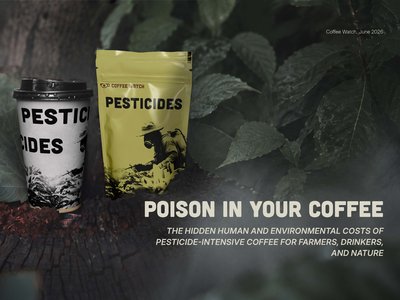
New Report: Poison in Your Coffee Reveals How Widespread Use of Highly Hazardous Pesticides Threatens Farmers, the Environment, and Coffee Consumers
Berlin, 22 June 2026 — A major new report released today by Coffee Watch, Inkota, Deutsche Umwelthilfe, and Pesticide Action Network, exposes a largely invisible crisis brewing in the heart of the global coffee industry: the widespread use of Highly Hazardous Pesticides (HHPs) across coffee-producing countries, including chemicals linked to cancer, neurotoxicity, reproductive harm, endocrine disruption, and catastrophic biodiversity loss.
The report, Poison In Your Coffee, synthesizes scientific literature, government data, and field research across Brazil, Vietnam, Kenya, Colombia, and other major producing regions. It reveals that coffee—one of the world’s most valuable commodities and a daily ritual for billions who think their beloved morning cup is safe—has become deeply dependent on pesticides banned in many of the countries that consume it.
Scale and toxicity: a system out of control
The report documents:
- Residues in our cups including toxic cocktails of residues of multiple hazardous pesticides
- 159 pesticide active ingredients used in coffee across major producing countries
- 60% classified as Highly Hazardous Pesticides
- 59% banned in the European Union
- Up to 20 pesticide applications per season in some regions
- Workers dying and sickened due to applications of pesticides in coffee
- Glyphosate, classified as “probably carcinogenic,” still widely used despite global litigation and scientific warnings
- Severe ecological impacts, including toxicity to bees, fish, beneficial insects, and soil organisms
Brazil alone used 19.8 million liters of pesticides on coffee in 2015—more per hectare than maize or soy. Vietnam has seen pesticide use increase three- to five-fold in 25 years. In Kenya, coffee accounts for 27% of national pesticide use despite occupying far less land than staple crops.
The double standard: banned at home, exported abroad
The report highlights a stark regulatory hypocrisy: pesticides banned or tightly restricted in the EU and U.S. continue to be exported to coffee-producing countries, where oversight is weaker and farmers have fewer alternatives. Coffee grown with these chemicals is then legally imported back into consuming countries as long as residues fall within regulatory limits.
“We have here a textbook example of environmental injustice,” said Etelle Higonnet, Founder and Director of Coffee Watch. “Wealthy nations ban these chemicals to protect their own citizens, yet allow companies to export them to poorer countries where farmers have the least protection and the most to lose. Then, regulators allow beans contaminated with banned pesticides back in, so that coffee consumers end up drinking poison residues. This is sick.”
Human health impacts: farmers pay the price
Farmworkers and rural communities face repeated exposure through mixing, spraying, contaminated water, and drift from neighboring farms. Documented health effects include acute poisoning, respiratory distress, neurological symptoms, reproductive harm, endocrine disruption, and increased cancer risk. Children and pregnant women are especially vulnerable. “The people who grow our coffee are being routinely exposed to chemicals that would be illegal to use in the countries drinking it,” said Silke Bollmohr of Inkota. “This is a human rights issue as much as an environmental one.”
Environmental collapse: soils, water, and biodiversity under threat
The report details how pesticide-intensive coffee farming contaminates rivers and groundwater, degrades soil health, and drives biodiversity loss. Pollinators, beneficial insects, and earthworms—critical for ecosystem balance—are among the most affected. “We are in a mass extinction crisis,” warned Sheila Willis of PAN UK, “and yet pesticides in coffee are contributing to killing countless vital species.”
Alternatives exist—but require systemic change
The report outlines proven solutions, including agroecological farming, shade-grown systems, integrated pest management, and stronger regulatory frameworks. But farmers cannot transition alone: they need financial support, technical assistance, and market incentives that reward sustainable practices.
A call to action
The report urges governments, companies, and consumers to:
- End the export of pesticides banned for domestic use
- Strengthen residue monitoring and import controls
- Support agroecological transitions and farmer training
- Reform certification schemes to prioritize pesticide reduction
- Increase transparency across supply chains
“Every cup of coffee can poison us, or support a safe and healthy future,” said Svane Bender of DUH. “The solutions exist. What’s missing is the political will—and the consumer demand—to make the world a better place with every cup.”
Media contact: Etelle Higonnet, info@coffeewatch.org