FOR IMMEDIATE RELEASE
Problematic German coffee: New study by Deutsche Umwelthilfe reveals deforestation, pesticide use, and labor law violations in coffee supply chains
- Coffee still linked to deforestation, use of highly dangerous agricultural toxins, and labor law violations such as forced and child labor
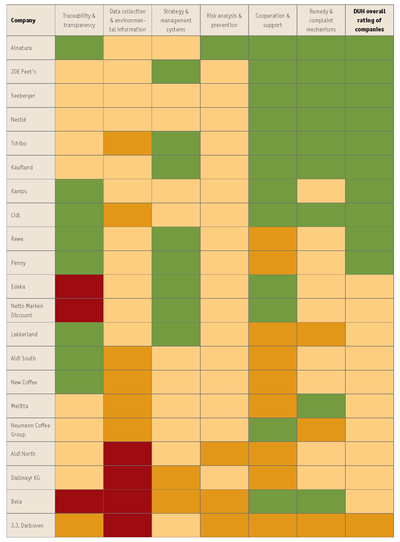
- Report ranks and grades coffee titans on compliance with German and EU sustainability regulations, based on self-reported information from 21 major German companies
- Best: Alnatura, JDE Peet's, Seeberger, and Tchibo score highly with significant efforts toward responsibility and transparency
- Worst: J.J. Darboven, Bela, and Dallmayr have a lot of catching up to do
- Results show postponement and weakening of laws at EU and German level would jeopardize progress towards sustainable supply chains
Berlin, 5 March 2026: German coffee consumption continues to be linked to deforestation, the use of highly toxic pesticides, and labor law violations. This is revealed in a new study by Deutsche Umwelthilfe (DUH) in cooperation with Coffee Watch. The study examines implementation of due diligence in coffee supply chains of 21 German companies in the retail, catering, and processing sectors based on self-reported information. The most significant shortcomings are in geographical recording of coffee cultivation areas and monitoring of hazardous agrochemicals. J.J. Darboven, Bela, and Dallmayr perform worst.
The analysis also contains good news: many coffee-importing companies are already investing in making their procurement more transparent and eliminating risks to people and nature from their supply chains. Alnatura, JDE Peet's, Seeberger, and Tchibo, among others, performed well in the study.
However, this positive development is under acute attack: key laws such as the EU Deforestation Regulation and the German Supply Chain Act have been threatened with delays.
Sascha Müller-Kraenner, Executive Director of DUH, comments: "Good coffee doesn't have to be bad for the environment. In recent years, some coffee companies have worked to increase transparency and responsibility in their supply chains. With the EU Deforestation Regulation, the German Supply Chain Due Diligence Act, and the EU Corporate Sustainability Due Diligence Directive, Germany and Europe established binding frameworks for great, sustainable standards. However, in recent months all of these regulations have been threatened, watered down, or delayed. The back-and-forth at the European level is making it impossible for responsible companies to plan ahead. They run the risk of being undercut by competitors who rely on cheap, exploitative practices. Coffee lovers’ desire for a product that is both environmentally friendly and respects human rights is being ignored. The positive developments of recent years must not be undone: the EU must be consistent and ensure it protects people and planet, so that Europeans aren’t unwillingly drinking slavery or deforestation in their coffee."
Svane Bender, Head of Nature Conservation and Biodiversity at DUH, adds: "Coffee is the sixth largest driver of global deforestation. Its production is associated with significant environmental and human rights risks, from biodiversity loss and water pollution to precarious working conditions and extreme poverty. We need laws to eliminate serious environmental damage and human rights violations from coffee supply chains. The EU Commission cannot allow any further weakening or delays in the EUDR and EUCSDDD. We expect the German government to maintain the level of ambition of the German Supply Chain Due Diligence Act and to enforce it consistently."
Table 1: Overall assessment resulting from questionnaires answered by 21 companies. Source: own illustration