

Share








Related
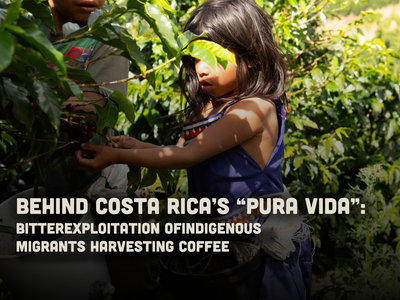
FOR IMMEDIATE RELEASE
New Investigation Reveals Widespread Exploitation of Indigenous Migrant Workers in Costa Rica’s Coffee
5 August 2026 – Today, Coffee Watch released a groundbreaking investigation exposing the hidden human rights abuses behind Costa Rica’s celebrated coffee industry. Despite the country’s reputation for strong institutions and sustainable agriculture, the report reveals that migrant farmworkers—primarily Indigenous Ngäbe-Buglé families from Panama—face dangerous working conditions, poverty wages, child labor, and systemic exclusion from legal protections. The report, “Behind Costa Rica’s ‘Pura Vida’: Bitter Exploitation of Indigenous Migrant Harvesting Coffee” highlights deep structural inequities and long‑standing patterns of racialized labor that disproportionately harm Indigenous communities in coffee worldwide.
Costa Rica is often held up as a model for regulated, traceable, and “ethical” coffee. Yet, a December 2025 field investigation found that the reality on the ground sharply contradicts the country’s public image. “Behind nearly every cup of Costa Rican coffee are exploited workers, whose suffering makes a mockery of Costa Rican greenwashing,” commented Coffee Watch director Etelle Higonnet.
A System Built on Migrant, often Indigenous Labor, and Deep Inequality
The coffee sector now relies almost entirely on migrant labor, with an estimated 70% of all coffee work performed by foreign workers. Thousands are Ngäbe-Buglé families coming from Panama’s Comarca area, where nearly 93.4% of the population lives in extreme poverty due to generations of structural discrimination and underinvestment. Many migrant coffee farmworkers walk for days through mountainous terrain to reach Costa Rica, often arriving hungry, exhausted, and in poor health. Once in Costa Rica, they do grueling work with few protections, desperately low pay, in terrible working and living conditions, without any hope of being able to join a union or leave their children somewhere safe.
Legal Protections Exist on Paper, Not in Practice
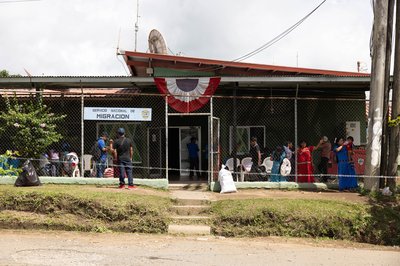
Costa Rica’s Migratory Labor Traceability System (SITLAM) is designed to provide temporary legal status, health access, and labor protections. But Coffee Watch found that thousands of workers fall through the cracks due to informal border crossings, lack of employer compliance, lost documents, and naming mismatches that prevent registration and which often stem from ignoring Indigenous naming practices. The report notes, “The result is a two-tiered system where legal protections exist on paper but remain inaccessible to many who need them most.” This exclusion disproportionately affects Indigenous families and undermines their rights under international law, including Free, Prior and Informed Consent (FPIC) and equal protection.
Wages Far Below Legal Minimums, 12-Hour Days, and No Ability to Organize
The vast majority of migrant workers on coffee farms earn well below what would be a living wage for rural Costa Rica, namely US $962 (₡483,674) per month.
Farmworkers are typically paid using a piece-rate pay system based on the amount they harvest, with the Costa Rican legal minimum rate set at ₡1,165.11 (about US$2.35) per cajuela (basket) of coffee cherries picked. While earnings vary depending on productivity, terrain, and informal payment arrangements, most pickers earn between US$16 and US$40 per day, with only exceptionally fast workers reaching US$50–60. At typical harvesting rates, coffee pickers working a standard five-day week cannot earn a living wage and generally only approach or exceed it by working six days a week, often for hours far beyond legal limits. Many work from 5 am to 5 pm, 6 days a week—far beyond the legal maximum of 8 hours per day and a maximum workweek of 48 hours. These twelve hour workdays are a flagrant, routine, commonplace violation of local law.
Our investigation also found that, in some cases, families combine their harvested cajuelas so that a single worker is paid for the labour of multiple family members, obscuring the true earnings of individual workers.
There are no unions for most coffee workers. Unionizing the overwhelmingly Nicaraguan and Panamanian seasonal farmworkers is nearly impossible due to legal restrictions on foreign leaders in unions and the transient nature of harvest work as well as corporate failure on this front. Without unions, farmworkers have little or no recourse or way to demand better conditions and decent pay.
Appalling Living Conditions
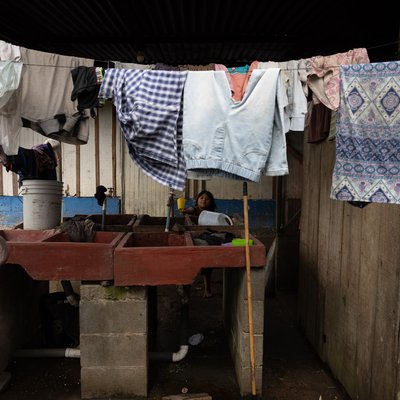
Most living conditions for coffee farmworkers are appalling. Overcrowded, flimsy, unable to keep out wind and rain, boiling hot in the sun at midday, they have limited water, sanitation, and electricity. Investigators found workers living in overcrowded wooden barracks with dirt floors, no mattresses, limited water, and open fire pits for cooking. At one farm, “faucets and sinks were installed but none had running water… residents reported carrying water from a river located down a steep mountain path.” Even farms certified by major international buyers failed to meet basic standards. These conditions violate workers’ rights to health, safety, and dignity.
Child Labor Is Common and Conditions Are Dire
This report distinguishes between Ngäbe-Buglé children's participation in traditional cultural practices and child labour in the commercial coffee industry. The concern addressed in the report is the commercial exploitation of children caused by government and industry failures to protect children’s rights, and provide access to education and safe, culturally appropriate childhoods.
The true scale of child labour in Costa Rica's coffee sector remains unknown. While the ILO estimates that 8% of children nationwide are engaged in child labour, the rate is likely significantly higher in coffee-growing regions, where Ngäbe-Buglé families experience disproportionate poverty and informal employment. National survey data found more than 30,000 children engaged in economic activity in 2016, including one-third in agriculture, while earlier national data identified at least 1,422 children working in the coffee sector. These figures point to a persistent failure by government and industry to prevent children from entering commercial agricultural work.
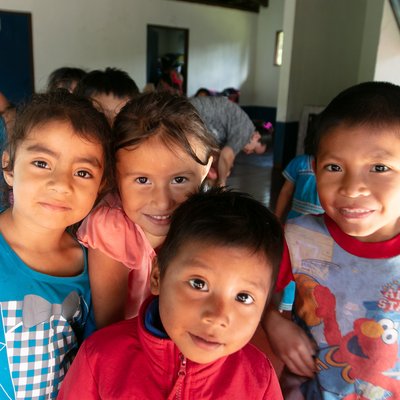
Coffee Watch also documented gendered child labor that often has been invisible in Costa Rican coffee: little girls left behind to care for younger siblings, including babies, often for 10 or 12 hours at a time, in shacks in conditions that were unfit for children. Underpaid and exploited parents often have no choice between leaving children in charge of babies, or bringing them to dangerous conditions in the field. While the little girls in charge of caretaking suffer, and are robbed of their childhood, the babies’ wellbeing remains uncertain without competent adults to care for them.
Casas de la Alegría (child care centres), are a program developed in collaboration with Indigenous communities, to provide culturally relevant, safe spaces for children up to age 12 during the coffee harvest while reducing previously documented child labour and protecting children left unsupervised. Yet the program is falling far short of need. Limited funding, reliance on voluntary farm participation, and insufficient capacity mean thousands of children remain without access, while those aged 12 to 15 are left with few alternatives but to remain alone in worker housing or accompany adults into the fields. Strengthening and expanding Casas de la Alegría is essential to ensuring Indigenous children can experience safe, culturally grounded childhoods instead of being pushed into commercial labour.
“Millionnaire coffee company executives wouldn’t leave their kids locked in a shack with an 8 year old in charge, no potable water and no electricity,” commented Higonnet. She added, “Why do coffee companies think this is ok for Indigenous workers’ kids if it’s unacceptable for their own children?”
A Call for Accountability
Coffee Watch urges the government and companies to confront the reality that Costa Rica’s coffee sector—despite its strong institutional framework—depends on the exploitation of Indigenous migrant labor. “Costa Rica markets its coffee as ethical and sustainable, but many if not most workers who make the harvest possible are living in poverty, danger, and suffering,” said Higonnet. “The government and industry should step up urgently and decisively, and clean up their act — in genuine partnership with Indigenous communities and grounded in Free, Prior, and Informed Consent.”
About Coffee Watch: Coffee Watch is an independent watchdog organization dedicated to exposing abuses in global coffee supply chains and advocating for the rights of forests, farmers, workers, and communities.