

Share








Trase has just released a major open dataset that provides new insight into global coffee supply chains. The data helps clarify which companies buy and export coffee, where trade flows are concentrated, and where greater transparency is still needed.
For organizations working on forests, climate, human rights, and responsible sourcing, this release offers an important new evidence base for action.
Key findings:
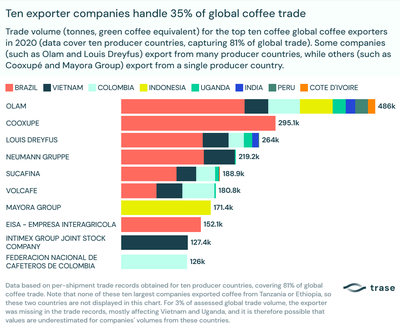
1. Ten companies account for 35% of global coffee exports
The concentration of global coffee exports among a small number of companies creates both risk and opportunity. Improvements by these companies could influence practices across a significant share of the sector.
2. Four countries produce approximately two-thirds of the world’s coffee
Brazil, Vietnam, Colombia, and Indonesia play a central role in the global coffee market. Coordinated sustainability action in these four countries could substantially reduce environmental and human rights risks across the sector.
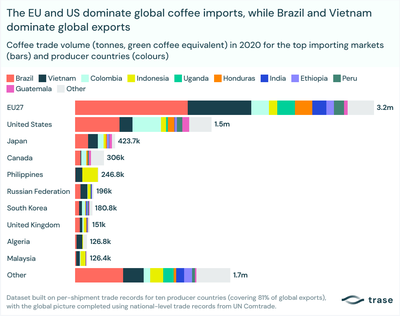
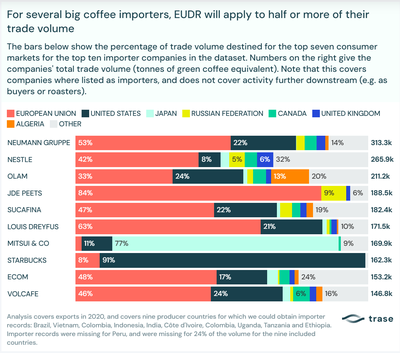
3. Companies shipping to the EU handle almost 80% of global coffee imports
This reach gives the EU Deforestation Regulation significance well beyond Europe. If companies apply its standards consistently across their global supply chains, the benefits could extend to producers, communities, and ecosystems worldwide.
4. Significant transparency gaps remain
Despite recent investigations, including Coffee Watch reporting on coffee-linked deforestation in Vietnam and Brazil, and new mapping initiatives, the sector still lacks sufficient data to trace coffee to its origin and reliably connect supply chains with deforestation and human rights risks.
5. Trase’s new method expands the potential of supply-chain analysis
The new approach is simpler, scalable, and able to cover a larger share of global trade. It offers a practical foundation for more consistent analysis and greater accountability across complex commodity supply chains.
6. Coffee production is highly vulnerable to climate change
Research indicates that up to half of the land currently suitable for coffee production could become unsuitable as the climate changes. Agroforestry is an important strategy for strengthening resilience while supporting biodiversity and producer livelihoods.
7. The dataset provides a clear call to action
Governments, companies, investors, and civil society can use this data to strengthen due diligence, improve sourcing practices, and accelerate progress toward coffee supply chains that are deforestation-free, equitable, and resilient.
Advancing responsible coffee supply chains
We congratulate the Trase team, including Mark Titley, Simon Croft, Jo Cook, Michael Lathuillière, Harry Biddle, Nicolas Martin, and all contributors to this substantial data release. Their work provides a valuable resource for efforts to build ethical, deforestation-free, and farmer-centred coffee supply chains.